
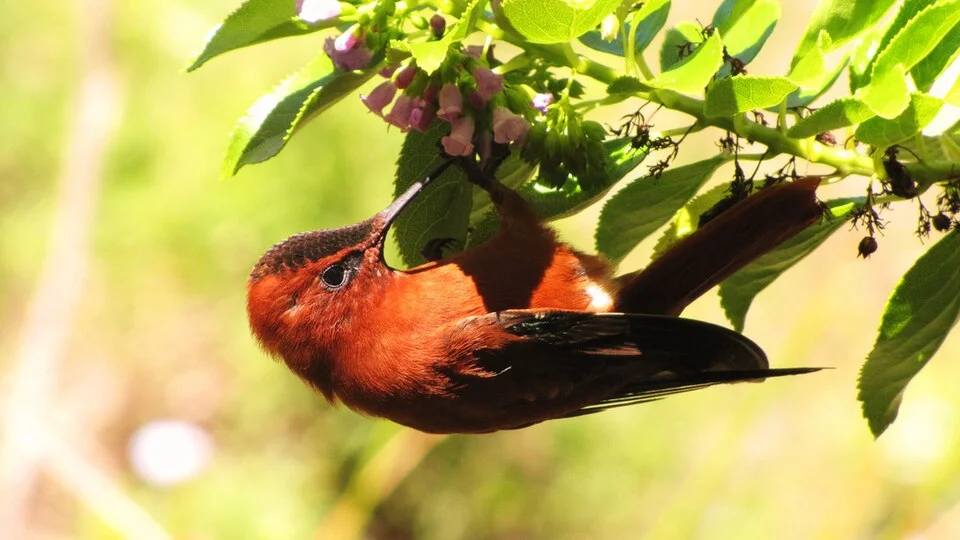
The Juan Fernández firecrown: 500 individuals on the edge of the abyss
The Sephanoides fernandensis, unique in the world, faces its greatest threat: the destruction of native forest by invasive species. With only ~500 specimens estimated, it is one of the most endangered hummingbirds on the planet.
On Robinson Crusoe Island lives one of the most singular and endangered hummingbirds on the planet: the Juan Fernández firecrown, or Sephanoides fernandensis. The male, with its blazing cinnamon-orange plumage and iridescent crown, is virtually impossible to mistake. The female, with bluish-green tones above and white with black spots below, was classified for decades as a separate species — so extreme is the difference between sexes that only the discovery of a nest containing both adults ended the scientific debate.
An absolute endemic
This species exists nowhere else on Earth. Confined to the main island of the archipelago, it depends entirely on native forests of coligüe bamboo, tree ferns and trees such as Myrceugenia fernandeziana, where it builds its nest and obtains nectar from plants like Rhaphithamnus venustus and Sonchus brassicifolius — the latter also critically endangered. This bidirectional dependency makes the firecrown a perfect indicator of the health of the island ecosystem.
The numbers of decline
BirdLife International estimates the total population at just 1,500 to 3,500 mature individuals, with a declining trend. The IUCN classifies it as Critically Endangered. The main threats are the spread of invasive plant species — especially bramble (Rubus ulmifolius) and maqui (Aristotelia chilensis) — which destroy the understory where the bird nests and forages. Added to this are predation by feral cats and competition with the more abundant green-backed firecrown (Sephanoides sephaniodes).
Conservation in progress
Since 2004, an alliance between The Hummingbird Society, American Bird Conservancy, and Oikonos has worked actively on the island: replanting native species, removing invasive plants, and controlling predators. The program has integrated the residents of San Juan Bautista as project coordinators, making conservation part of local identity. However, the scale of the problem — 80% of native forest already compromised — means efforts remain insufficient without sustained institutional support.
Visiting Robinson Crusoe is also an act of responsibility: every tourist who understands the value of this unique hummingbird becomes an involuntary ally of its survival.